The quote from Unipile is on your screen, or someone has asked for a second name on the shortlist. Either way, you want a Unipile alternative that reaches the channels your customers live in. Pick aux0 if you need LinkedIn or WhatsApp alongside mail and the rest, and Nylas if you need mail and calendar only. Linked API suits a LinkedIn-only tool, Unified.to suits OAuth inboxes like Slack and Zendesk, and Twilio suits WhatsApp from a business number on Meta's route. Build it yourself if channels are your product.
aux0 publishes this post, and aux0 is our top pick. As of November 2026, it is cheaper than Unipile at every published size up to 1,000 connected accounts: $40 against $55 at 10, and $400 against $500 at 100. It reaches twelve providers, Slack and X among them, where Unipile's page lists no Slack and shows X as not yet available. One connected account is free, with every provider and 1,000 calls a month. Budgets, activity windows and webhook replay come with it, and the MCP server takes read-only keys that never see a write tool. The feature-by-feature split is at aux0 vs Unipile.
Channels pick the shortlist. Operations pick the winner: what the provider does the week a session breaks, a limit gets close, or your webhook endpoint goes down.
The comparison at a glance
Unipile is the baseline in every row. Prices are monthly list prices in USD, before tax, from each vendor's own pricing page, with Linked API's one caveat in its section.
| Option | Reaches | 10 accounts | 100 accounts | Free plan or trial | SOC 2 | Best for |
|---|---|---|---|---|---|---|
| aux0 | All twelve providers, incl. LinkedIn, WhatsApp, Slack and X | $40 | $400 | 1 account, 1,000 calls a month | Certified | LinkedIn or WhatsApp plus other channels |
| Unipile (baseline) | LinkedIn, WhatsApp, Telegram, Instagram, mail, calendars; X not yet available; Slack not listed | $55 | $500 | 7-day trial | Certified, per its pricing page; another of its pages says in progress | Teams already built on it |
| Nylas | Mail, calendar, contacts; no LinkedIn, WhatsApp or Telegram | $15 | $199 | 5 accounts, "free forever" | Type II report under NDA | Mail and calendar only |
| Linked API | LinkedIn only, incl. Sales Navigator | $490 at list | $4,900 at list; volume plans on request | 7-day trial | Not stated on its pricing page | A LinkedIn-only tool with few seats |
| Unified.to | Slack, Teams, Gmail, Outlook, Zendesk and more over OAuth, as of 1 November 2026; no LinkedIn | From $750, calls metered | From $750, calls metered | Test plan, 30 days, not for production | Type II compliant | OAuth SaaS inboxes at call-based pricing |
| Twilio (WhatsApp Business API) | WhatsApp from a business number | Per message | Per message | None, pay per message | Not compared here | WhatsApp notifications from a business number |
| Build it | Whatever you build | Your team's time | Your team's time | Not applicable | Yours to earn | Messaging as the product |
Most rows split on the channel column before anything else. Open the pricing pages first and Nylas's $15 next to Unipile's $55 looks like a bargain. It is one, for mail and calendar. It just does not buy LinkedIn.
What no cell can show is operations: what each provider does when a session breaks or a limit gets close. That gets its own look in aux0's section, set against Unipile's.
Start from the channels you need
There are three ways a product reaches a user's channels, and each one closes some doors before you've compared a single price.
- Account-based. Your end user links their own account on a hosted page and the provider acts as them, with their session, so it reaches what they can: LinkedIn messages, invitations, their own WhatsApp threads. aux0, Unipile, Linked API and a build of your own work this way.
- OAuth-only. The user approves your app on the platform's consent screen, and you get whatever that platform's API exposes. Nylas and Unified.to work this way, which is why they're strong on mail, calendars and Slack-style workspaces and absent on LinkedIn.
- The official route. The platform's own business API: the WhatsApp Business API through a provider such as Twilio, or LinkedIn's partner programme.
OAuth can't reach LinkedIn messaging because LinkedIn does not offer it to ordinary apps, which is the gap account-based access fills. Its Messages API is restricted to approved partners, and the actions it allows "do not include an automated or scheduled event". WhatsApp has the mirror problem: Meta's route sends from a business number with templates, and never touches the user's personal threads or groups.
An OAuth unified API will wire Slack and Gmail into your product in an afternoon, and for a week you feel clever. Then sales asks for LinkedIn, and it is not on the list.
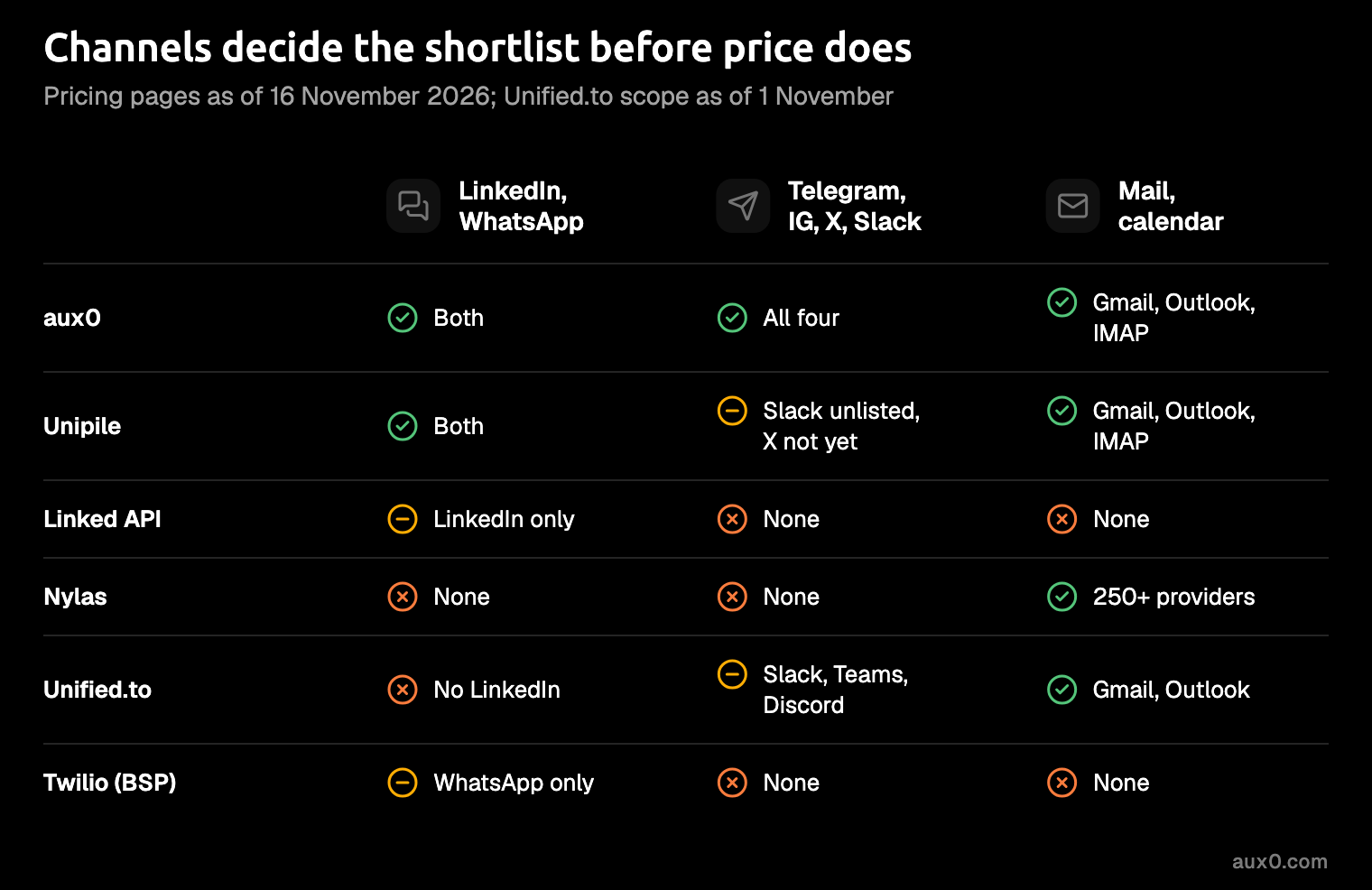
If LinkedIn or a personal WhatsApp number is on your list, the field shrinks to the account-based options. If you also need Slack or X in the same integration, it shrinks to aux0 or your own build.
The alternatives, one by one
1. aux0: the pick for LinkedIn and WhatsApp alongside everything else
aux0 is an account-based API. Your users link their accounts through hosted auth, entering their password, QR or code on aux0's own page, and you get an account id and a webhook. One object model covers twelve providers: LinkedIn, WhatsApp, Telegram, Instagram, Messenger, X, Gmail, Outlook, IMAP and SMTP, Google Calendar, Outlook Calendar, and Slack. Unipile's pricing page lists X as not yet available and does not list Slack.
The price is per connected account, never per message. The first 10 accounts are $40, then it is $4 an account, $3.50 from account 111 and $3 from 211, with custom pricing above 1,000. 50 accounts is $200 against Unipile's $275, and 500 is $1,660 against $2,250. The free account gives you every provider and 1,000 calls a month, and when you go paid it is one of the 10 the $40 covers, not an extra.
The operations are where aux0 earns its place:
- A send that would cross a provider window is
queued, not rejected, andGET /v1/accounts/:idshows every window and the budget left in it. - Each account has an activity window per weekday in its own timezone, and new accounts are warmed up automatically.
- Each account egresses from one residential IP (an address on a home connection, not a data centre) in its own country, pinned for its life.
- When the platform shows a checkpoint (a page asking the user to prove it is really them), aux0 detects it, queues the sends, and fires
account.needs_attentionwith a reconnect link your user usually finishes in under a minute. - Webhooks are HMAC-SHA256 signed, and failed deliveries are held for 7 days so you can replay them.
The infrastructure page walks through each one. On Unipile's side, webhooks retry five times with an incremental delay and expect a reply within 30 seconds; replay and signing are not described on the page we checked. Linked API's comparison says Unipile's v1 treats LinkedIn limits as recommendations and leaves checkpoints to your app, with a five-minute window to handle them. By the same account, its v2, still in preview, rejects over-limit calls before they reach LinkedIn.
A send that would cross a limit should be held, not rejected, because a caller that gets an error tends to retry. Think of the on-call engineer who learns in the small hours that LinkedIn sends have been failing on a checkpoint since lunch. A held queue and a webhook that said so would have made it a non-event. Operations are where a messaging integration lives or dies after launch.
For agent products, the MCP server exposes 12 tools, 6 read and 6 write, and a read-only key never advertises the write tools. Pacing applies to your agent exactly as it does to your code. Unipile has an MCP server too, so treat MCP as a tie.
Security is close to even, with one wrinkle. aux0 is SOC 2 certified, and so is Unipile, by its pricing page. An undated Unipile comparison page still lists the audit as in progress, so ask for the report before you sign. aux0 runs a Google-verified OAuth app, and so does Unipile by default on its self-serve plans, so on those you skip Google's verification and CASA assessment with either.
What aux0 does not have, each with its answer:
- No SDKs or n8n and Make nodes. Unipile and Linked API have both. aux0 is plain REST from any language that speaks HTTPS, and the MCP server lets your coding agent write the typed client.
- Calls are capped. Unipile says API calls are unlimited on every tier, with only provider limits applying. aux0 caps calls per plan but charges nothing per send, receive, webhook or replay; check the cap on pricing.
- Younger, with a shorter record than Unipile's. The free account is there so you can test it on your own product first.
- The platform can restrict an account. LinkedIn says members using automation "risk having their accounts restricted or shut down", and that holds for every account-based option here. Hosted auth, pacing, a pinned IP, warm-up, the user's own account and their informed consent lower the risk. Nobody can promise it away.
Best for: any product that needs LinkedIn or WhatsApp alongside mail, calendars, Slack or the rest, from the first account to 1,000.
2. Nylas: best for email and calendar only
Nylas covers email, calendar, contacts, Scheduler and Notetaker over OAuth, and lists "250+ email, calendar and meeting providers". It does not reach LinkedIn, WhatsApp or Telegram. The Free plan is $0 for 5 accounts, "free forever"; Essentials is $15 a month for 10 accounts then $2.25 each, and Pro is $49 for 25 then $2.00 each. Its SOC 2 Type II report is available under NDA.
If mail is all you need, Nylas is the cheaper and broader choice, and you should take it. It's the wrong tool the day sales asks for LinkedIn. aux0 puts Gmail, Outlook and IMAP in the same model as LinkedIn and WhatsApp, so that day means one more provider, not a second vendor; aux0 vs Nylas has the detail.
Best for: products that sync or send mail and calendar, and nothing else.
3. Linked API: best for a LinkedIn-only tool with few accounts
Linked API is LinkedIn only, including Sales Navigator, with an API, SDK, CLI, MCP access, and n8n and Make integrations. It costs from $49 per seat a month on Core and $74 on Plus, where one seat is one LinkedIn account. The pricing page does not state the billing period, and Linked API's comparison page gives $49 as the annual rate and $69 month to month. At the Core list rate, 10 seats come to $490 and 100 to $4,900, before the volume and custom plans it offers on request. Both plans have a 7-day trial. Each account runs in a dedicated cloud browser, with per-action limits that return a limitExceeded error when crossed.
The tooling is strong, and if your team lives in n8n it is ready today. The catch is that the list price scales per seat, so ask about volume pricing before you pass a handful of accounts.
Best for: a LinkedIn-only product with few seats, or one that needs n8n or Make nodes now.
4. Unified.to: best for OAuth SaaS inboxes at call-based pricing
Unified.to is an OAuth unified API. As of 1 November 2026, its messaging category covered Slack, Teams, Gmail, Outlook, Discord, Intercom and Zendesk, among others; LinkedIn is not supported and WhatsApp is not mentioned. The Test plan is $0 with 10,000 calls, free for 30 days and not for production. Grow starts at $750 a month with 750,000 calls and $1.00 per 1,000 beyond, and every plan allows unlimited connections. The pricing page says it is SOC 2 Type II compliant.
It is priced for call volume, not accounts. That suits many accounts with light traffic, and it ties your bill to how chatty your sync is rather than how many users connect.
Best for: products that need Slack, Teams, mail and support tools under one OAuth API, at volume.
5. WhatsApp Business API through a BSP (Twilio): best for WhatsApp notifications from a business number
This is Meta's official route, through a business solution provider (BSP) such as Twilio, and anything you send outside the 24-hour service window has to be an approved template. Twilio adds $0.005 per message, inbound or outbound, on top of Meta's per-message fees. Meta charges $0.0034 for authentication and service messages, and the same for utility templates sent outside that window; inside it, utility templates are free.
It's the right route for order updates and one-time codes sent to your customers. It's the wrong one for acting as a user: it cannot reach your user's own threads or groups, which an account-based WhatsApp link by QR can, with no templates or per-message fee. The trade-off is that the phone must come online now and then, and aux0 vs the WhatsApp Business API weighs the two.
Best for: transactional WhatsApp from a business number you own.
6. Build it yourself: best when messaging is the product
You can build it, and the first version is quick. Then you take on hosted auth, sessions, pacing, proxies, checkpoint recovery and webhook delivery, for every channel, for as long as the product exists.
The official doors are narrow. LinkedIn's Messages API is for approved partners and excludes automated or scheduled sends, LinkedIn says automation software is not permitted, and its User Agreement, effective 3 November 2025, bars bots and unauthorised automated access. For a sense of what happens when a platform pushes back, Proxycurl announced its shutdown on 4 July 2025 to comply with a legal settlement with LinkedIn, after a suit filed in January 2025.
The prototype is easy. Keeping it alive is the job. Build vs buy puts the two side by side.
Best for: teams for whom channels are the product, with someone who will own them indefinitely.
What it costs at your size
Per-account, per-seat, per-call and per-message pricing answer different questions, so this table compares like with like where it can. All figures are monthly list prices, in USD, before tax:
| Option | What it buys | 10 accounts | 50 accounts | 100 accounts | 500 accounts |
|---|---|---|---|---|---|
| Unipile | All its channels | $55 | $275 | $500 | $2,250 |
| aux0 | All twelve providers | $40 | $200 | $400 | $1,660 |
| Linked API | LinkedIn seats, Core list rate | $490 | $2,450 | $4,900 | $24,500 |
| Nylas | Mail and calendar only | $15 | $99 | $199 | Pro plus $2.00 per account over 25 |
| Unified.to | OAuth APIs, calls metered | From $750 | From $750 | From $750 | From $750 |
| Twilio | WhatsApp, per message | Not per account | Not per account | Not per account | Not per account |
Unipile's figures apply its tier rate to every account, as its own pricing example does, while aux0's tiers are marginal, with $40 covering the first 10. Linked API's are seats times its $49 Core list rate, before any volume or custom plan. Nylas is Essentials at 10 and Pro monthly above, and Unified.to's real bill depends on your call volume. Twilio's depends on how many messages you send, at $0.005 each plus Meta's fee.
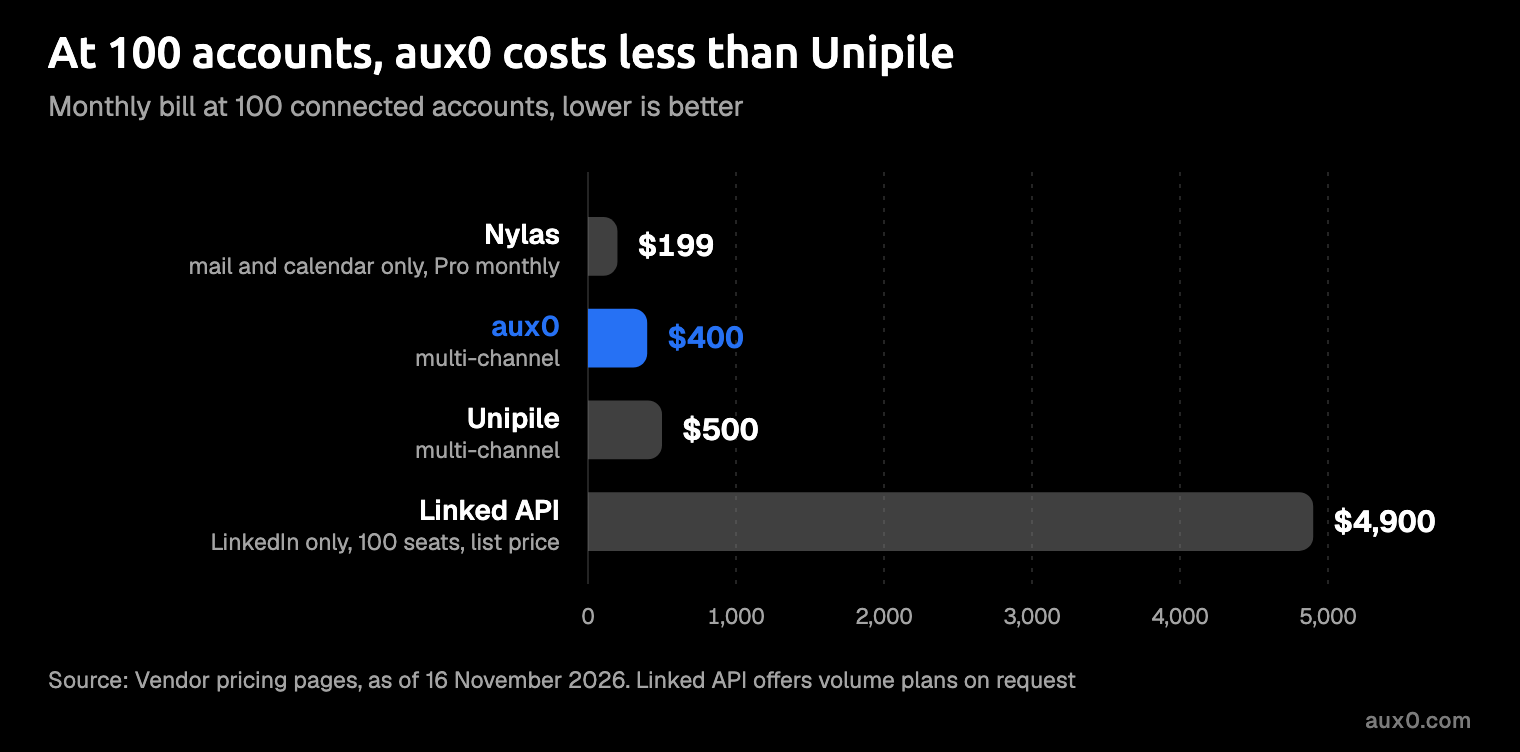
Set Nylas's mailbox price beside a LinkedIn seat and LinkedIn looks absurd. It is a different product. Compare the rows that buy your channels, then check the call cap on aux0's pricing page against your traffic.
Which one to pick
Start from your channel list, then your account count. If nobody can name the channel your next customer will ask for, ask your sales lead which one came up on last week's calls. That one decides it.
- LinkedIn or WhatsApp, plus anything else: aux0. It costs less than Unipile at every published size up to 1,000 accounts, and it adds Slack and X.
- Mail and calendar only: Nylas.
- LinkedIn only, a few seats, n8n or Make today: Linked API.
- Slack, Teams and support inboxes at volume: Unified.to.
- WhatsApp from your own business number: Twilio or another BSP.
- Messaging is the product: build it, and staff it.
If your list starts with LinkedIn or WhatsApp, connect one account on aux0's free plan and send your first message with the quickstart. Prove it on your own product before anyone signs.