Someone in finance has asked what the LinkedIn integration will cost next year, and Unipile's pricing page has handed you a rate card instead of an answer. Here's the answer, with Unipile pricing as of November 2026: $55 a month at 10 connected accounts, $275 at 50, $500 at 100 and $2,250 at 500, before VAT.
aux0 publishes this post, and on the same four sizes aux0 comes to $40, $200, $400 and $1,660. The feature comparison lives at aux0 vs Unipile. This one is only about the bill.
The rate card isn't the bill. The counting rules are, and they're where a budget goes wrong.
Unipile's pricing model in one table
Unipile charges per linked account per month, whatever the channel: a LinkedIn profile costs the same as a Gmail inbox or a WhatsApp number. The rate per account falls as your count rises, in bands.
| Linked accounts | EUR | USD |
|---|---|---|
| Up to 10 | €49.00 a month, total | $55.00 a month, total |
| 11 to 50 | €5.00 each | $5.50 each |
| 51 to 200 | €4.50 each | $5.00 each |
| 201 to 1,000 | €4.00 each | $4.50 each |
| 1,001 to 5,000 | €3.50 each | $4.00 each |
| 5,001 and up | €3.00 each; custom pricing available | $3.50 each; custom pricing available |
The page lists euros first with a dollar switch, and this post quotes dollars from here on. Billing is post-paid, with an invoice at the end of each 30-day period. There's no charge per request or per message, and you can cancel anytime. The trial runs 7 days with no card, and prices exclude VAT.
It's a simple table to read and an easy one to misread. If you've ever filed a tax return, you'll assume the bands work like brackets: one price for the accounts in the first band, another for the accounts in the next. Their FAQ says otherwise.
How the bill is worked out
Three rules decide the invoice: the minimum, the tier rate, and which count gets billed.
The minimum covers up to 10 accounts
The minimum is a floor, not a per-account price. If you're early, you may spend your first months here, building against a few test accounts and a friendly design partner, and paying the full floor either way.
Three accounts is $55, and so is ten.
The tier rate applies to every account
Once you pass 10, their own example bills every account at the tier rate, not just the accounts inside the band. The case in their FAQ is 20 users who each link LinkedIn, WhatsApp and Gmail: 60 accounts at €4.50 each, so €270 a month. The page itself only says that the more accounts you link, the lower the cost per account; the example is what shows the method.
A flat rate on the whole count rewards crossing a threshold. That's generous just past each line and expensive just short of it, which is how you get cliffs.
The tier cliffs
On that method, adding accounts near a boundary can lower the bill. At 50 accounts you pay $275; at 51, every account drops to $5.00 and the bill is $255. At 200 it's $1,000 and at 201 it's $904.50; at 1,000 it's $4,500 and at 1,001 it's $4,004. The bands are inclusive as the page lists them, so 50 still sits in the $5.50 band.
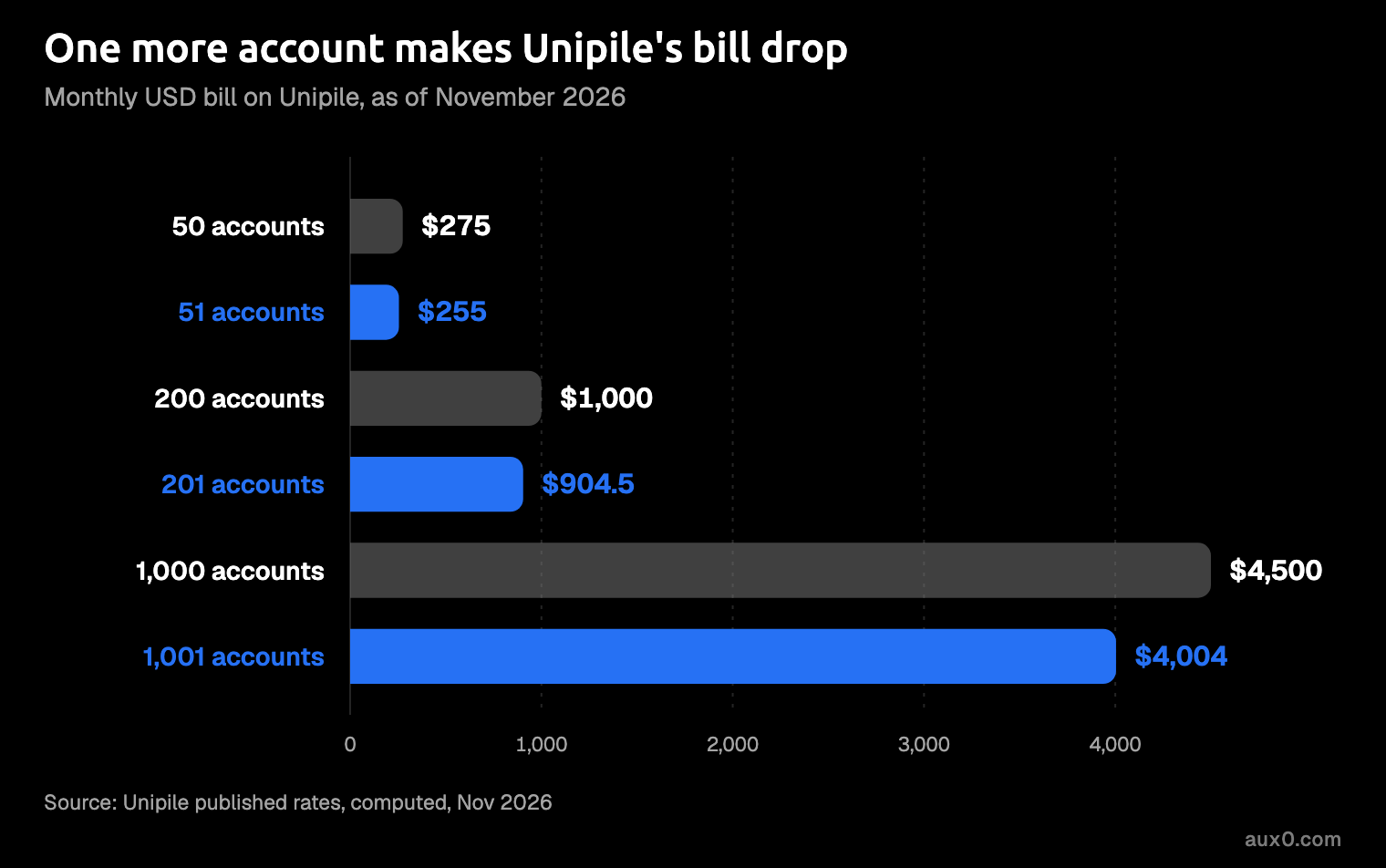
Near a boundary, adding an account lowers the whole bill. Sooner or later someone in finance will see the invoice fall in a month your usage grew and ask whether the integration broke.
It didn't. You crossed a line.
Peak accounts, not average
Unipile bills on the peak number of linked accounts active at the same time during the 30-day period, not your average. For a product with trials and churn, that peak is the number that matters.
Picture onboarding week. A customer connects their whole sales team to try your product, the trial ends, and most of them disconnect again. The invoice remembers the busiest day.
Say you run at 100 accounts all month, a $500 bill, and for one day you touch 211. That day sets the invoice: 211 accounts at $4.50 is $949.50. Before you design trials around this, ask Unipile how disconnected accounts count toward the peak.
Budget on your peak, not your month-end count.
Worked bills at 10, 50, 100, 500 and 1,000 accounts
Both vendors price per connected account and charge nothing per message, so every bill is a count times a rate. What differs is the rate, and whether it applies to the whole count or band by band. Monthly, in USD, before VAT, with Unipile's rates as of November 2026:
| Connected accounts | Unipile | aux0 | aux0 lower by |
|---|---|---|---|
| 10 | $55 | $40 | $15 (27.3%) |
| 50 | $275 | $200 | $75 (27.3%) |
| 100 | $500 | $400 | $100 (20.0%) |
| 500 | $2,250 | $1,660 | $590 (26.2%) |
| 1,000 | $4,500 | $3,160 | $1,340 (29.8%) |
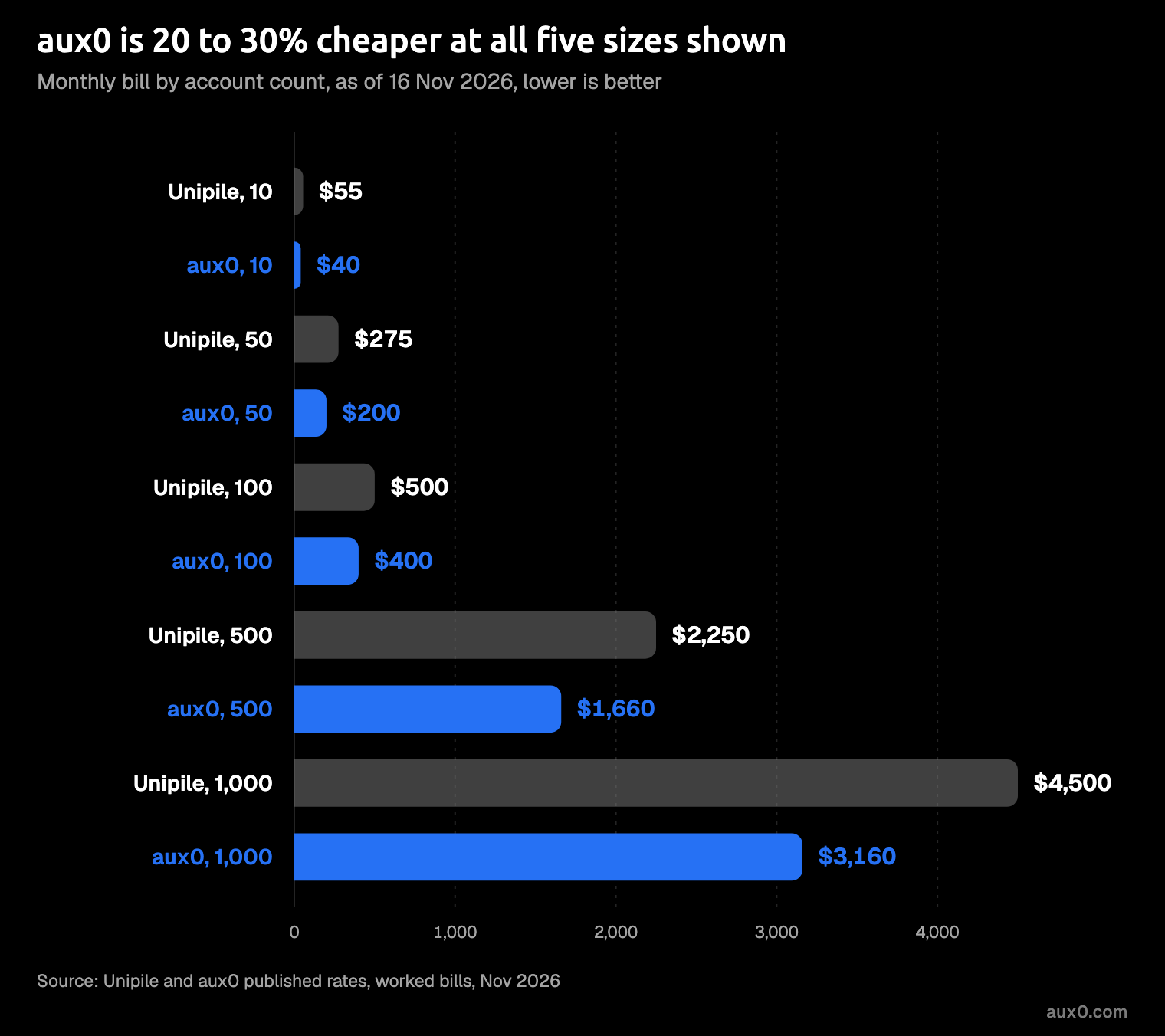
The method is plain arithmetic. Unipile is your count times its tier rate, with a $55 floor up to 10. aux0's $40 covers the first 10, then it's $4 an account up to 110, $3.50 from 111 to 210 and $3 from 211, each rate applying only to the accounts in its band.
At 500 accounts, Unipile is 500 × $4.50 = $2,250. aux0 is $40 + 100 × $4 + 100 × $3.50, plus $3 on each account from 211 to 500, which comes to $1,660.
On these numbers aux0 is between 20.0% and 29.8% lower at each of the five sizes in the table. Run your own count against the pricing page and you'll have a number you can defend.
Above 1,000 accounts, aux0 quotes a custom price, so there's nothing here to compare.
What each bill includes
Same kind of bill on both sides, so the rate is the difference. Neither charges per message: Unipile adds no cost per request or per message, and aux0 charges nothing per send, receive, webhook or replay.
Usage is where Unipile is ahead. Its page promises unlimited usage, with only provider limits applying, while aux0 caps API calls; the cap is on the pricing page.
Provider limits apply on both. aux0 queues a send that would cross a provider window instead of rejecting it, which is kinder to your users' accounts than a retry loop (how pacing works).
Both are SOC 2 certified, and Unipile's audit confirmation took effect on 19 October 2025. Both give you a Google-verified OAuth app, so you skip Google's verification and the CASA assessment. Unipile's shared app is on by default on standard self-serve plans, with CASA Tier 2 included. On Google this is parity, not a lead: the paperwork is gone on either bill.
Which channels each covers is a feature question, answered at aux0 vs Unipile. For the bill, what matters is that a LinkedIn profile and a WhatsApp number each count as one account.
Which to budget on
Start from your peak account count and how long you'll stay small.
- Under 10 accounts for months, either minimum works, and the gap is $15 a month. What differs is how you start: Unipile gives a 7-day trial with no card, and aux0 gives you one connected account free, with 1,000 calls a month, to build on before anyone signs. When you go paid, that free account is one of the 10 the $40 covers, not an extra.
- Between 10 and 1,000 accounts, aux0 is the lower bill at each size in the table. If you stay on Unipile, check whether your peak sits just under one of its boundaries.
- Above 1,000 accounts, aux0 goes custom, while Unipile publishes rates past 1,000 and quotes custom pricing beyond 5,000. Get a quote from aux0 and set it against Unipile's published rate for your count.
Your users won't see either invoice. Your finance team will see little else. Check your peak against the rates on the pricing page, then send a first message on the Free account with the quickstart.