You are pricing WhatsApp for a customer whose reps already talk to their clients there. You open the Meta rate card, add the Twilio fee of $0.005 on every message in and out, and the quiet customers on your list stop being worth the per-message maths. Then someone asks the obvious question: is there a WhatsApp API without a business account?
There is, and it is a different product. A SaaS can put WhatsApp in front of its users two ways: the WhatsApp Business API, or a linked number, which is the user's own WhatsApp connected by QR code the way WhatsApp Web is. This post prices both at three volumes, says what each cannot do, and tells you which one your product needs.
aux0 publishes this blog and sells the linked-number route, so check our sums. Each rate names its source, and every bill shows its arithmetic.
The two routes in one paragraph each
The Business API. Your customer registers a business number on the Meta platform, usually through a business solution provider (BSP) such as Twilio, and your product sends through it. A number already on WhatsApp has to be deleted from it first. A Business app number can stay through coexistence, minus its synced group chats, broadcast lists and linked devices. Meta bills per delivered message the business sends, by category and by the country of the recipient, and a BSP such as Twilio adds its own fee. Once 24 hours have passed since the user last wrote, you can only send templates, which Meta reviews first.
A linked number. Your user links the number they already have, personal or business, and your product joins it as a linked device. WhatsApp allows up to four linked devices per account, and each one connects independently of the phone. Your product sees what the user sees: their existing threads and their groups.
These are not two prices for the same thing. One gives a business an official channel on a registered number, and the other puts a person's own WhatsApp inside your software. You usually find out which one you need on a sales call, the moment a rep asks whether their clients will still reach them on the number saved in their phones.
How the Business API bills you now
The support thread that cost your customer nothing in September has a price per reply in October. On 1 October 2026, service messages, uncharged since November 2024, began costing the utility rate of their market, and so did utility templates sent inside an open window.
Meta has billed per delivered message since 1 July 2025, and only for messages the business sends; what users send you is free. Marketing, utility and authentication messages are templates. Service is the free-form reply you send while a conversation is open.
The open conversation is the customer service window. It opens for 24 hours when a user messages or calls the business, and resets with each new message from them. Inside it you can send anything; outside it, only templates. A user who arrives from a Click to WhatsApp ad opens a free entry point of up to 7 days, per the Meta developer docs, in which most messages are not charged.
Meta gives each number 1,000 free service messages a month, with no rollover, then charges. Its non-template page lists no free tier, so ask your BSP whether the allowance reaches you. Without a payment method on file, service messages past the free tier are not delivered.
Posts written before 1 October 2026 still call service messages free. Your customer's invoice won't.
The Meta rate card, effective 1 October 2026, in USD per delivered message. The per-country figures are relayed from the Kanal pricing guide, updated 9 November 2026, and the Courier pricing guide, updated 5 November 2026, which both read them from the Meta USD rate card; the model itself is on the Meta pricing page.
| Recipient's country | Marketing template | Utility, authentication and service |
|---|---|---|
| United States | Not delivered (listed at $0.0250) | $0.0034 |
| India | $0.0118 | $0.0014 |
| Brazil | $0.0625 | $0.0068 |
| Germany | $0.1365 | $0.0550 |
Meta changes rates only on 1 January, 1 April, 1 July or 1 October, and the October 2026 update moved 40 of them. The US marketing price is one you cannot spend: per Meta's docs, checked 16 November 2026, WhatsApp does not currently deliver marketing templates to US numbers.
Then the BSP adds its share. The Twilio pricing page, current as of September 2026, adds $0.005 per message, inbound or outbound, and $0.001 for each message that ends as failed. It also lists $0.0034 for utility, authentication and service, which matches the relayed rate card. Inbound is free from Meta but not from Twilio, so in a one-to-one chat every message costs you at least half a cent, whichever way it travels.
What a month costs on each route
Every bill here is hypothetical. Recipients are in the US, every message belongs to a conversation the client started (service traffic inside the window, no templates), half the messages are inbound, and Twilio is the BSP. The Meta free tier is assumed to apply to each number, and BSP platform or number fees are not included. The aux0 figures assume each account stays within its plan's call cap. There is no per-message fee, but there is a cap; pricing lists it.
On the Business API via Twilio, each number pays $0.005 a message, in or out. Outbound messages past its first 1,000 a month add $0.0034 each. aux0 costs $4 per connected account, with $40 as the minimum covering the first 10, and nothing per message.
| Hypothetical | Volume | Business API via Twilio | aux0 |
|---|---|---|---|
| A | 10 numbers, 500 messages each | $25.00 | $40 |
| B | 10 numbers, 5,000 messages each | $301 | $40 |
| C | 100 numbers, 5,000 messages each | $3,010 | $400 |
In A, half of the 500 messages on each number go out, all inside the Meta free tier, so the whole bill is the Twilio fee of $2.50 a number. In B, each number sends 2,500 messages out. Past the free 1,000, those 1,500 cost $0.0034 each, or $5.10. Twilio adds $25.00 for all 5,000 messages, in and out. That makes $30.10 a number. C is B with ten times the customers.
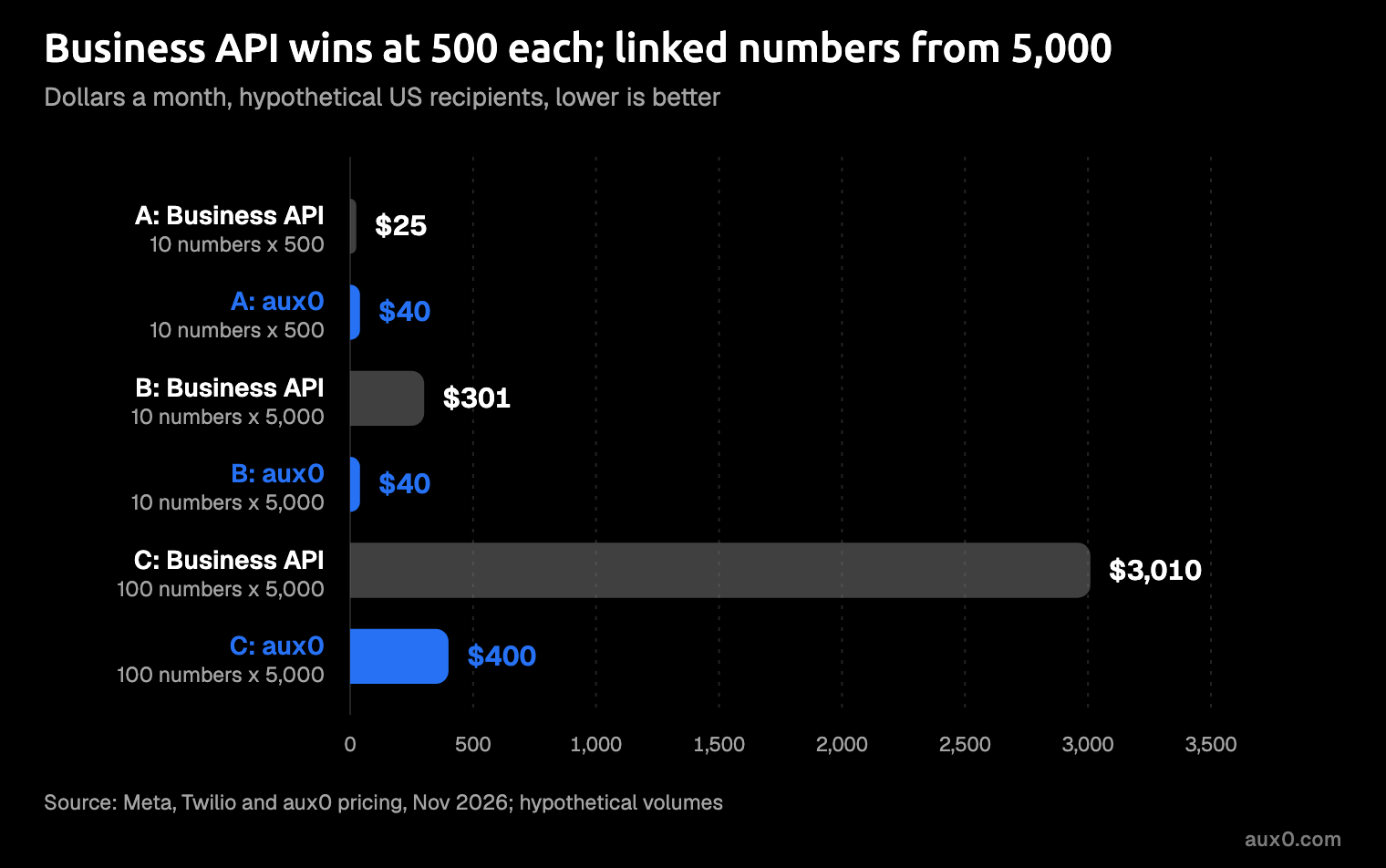
A favours the Business API, and plainly: $25.00 against the aux0 minimum of $40. If your customers' numbers are quiet, the per-message route is cheaper, and you should take it.
The question isn't how many numbers you have. It's how many messages each one sends. Picture two customers on your books, one whose rep sends 500 messages a month and one whose rep sends 5,000: on the Business API the first costs you $2.50 a number and the second $30.10, while on aux0 both are one connected account. A per-account bill is also one you can quote before your customer has sent anything, where a per-message bill moves with their volume, the countries of their clients and the quarterly Meta rate card.
Templates, when you need them, are priced per message. A US utility template sent outside the window costs $0.0034 from Meta plus $0.005 from Twilio, so $0.0084. A marketing template to a Brazilian number costs $0.0625 plus $0.005, so $0.0675. A linked number has no template line on its bill, because it has no templates.
Which one your product needs
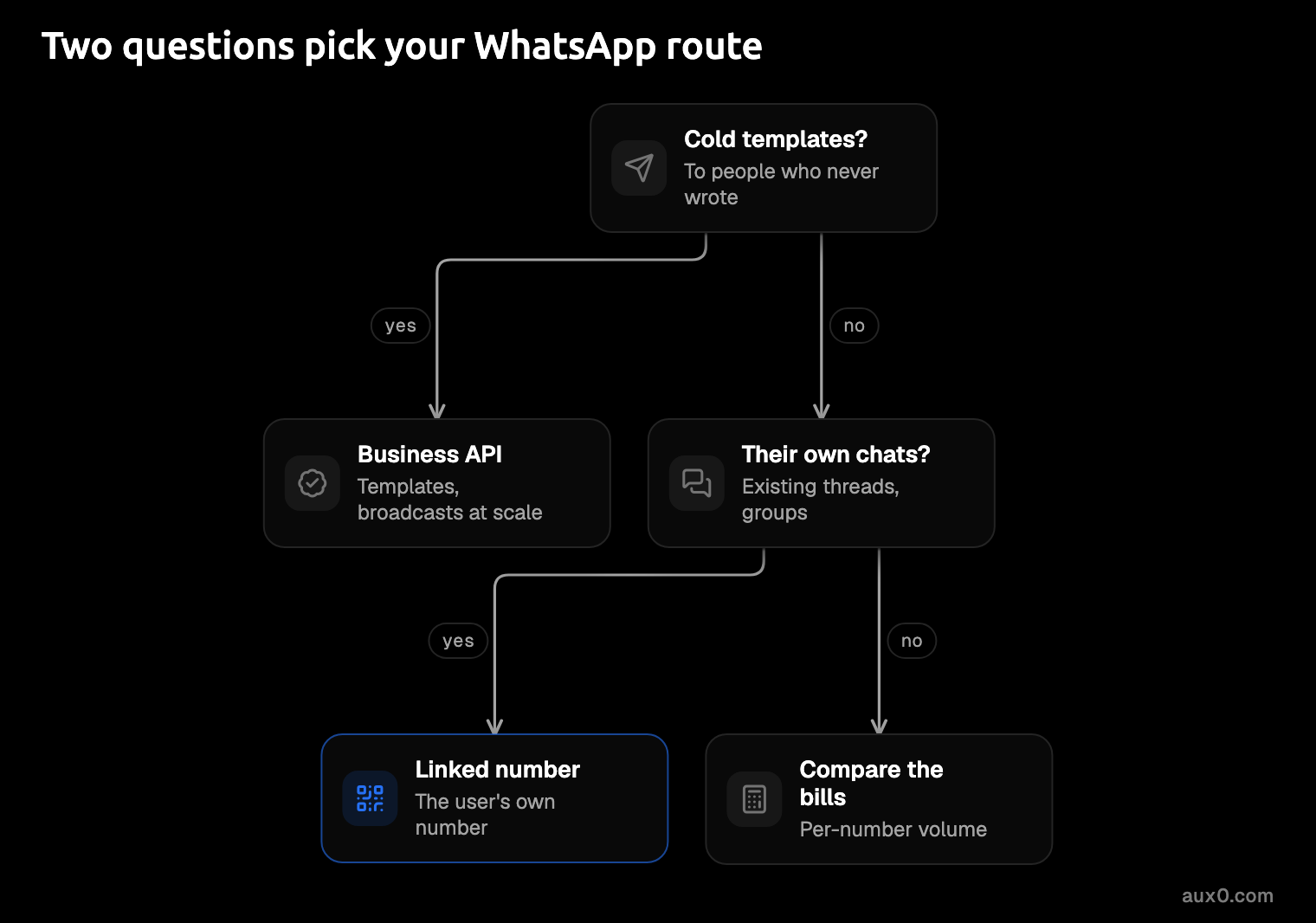
The route follows two things: who starts the conversation, and whose number it lives on. If your product writes first to people at scale, you want templates and the Business API. If your users already talk to their clients on WhatsApp and want those threads in your product, you want their numbers.
| If your product… | Pick | Why |
|---|---|---|
| Sends order updates, appointment reminders or one-time passcodes | Business API | Templates reach people outside the window, and utility and authentication messages get volume tiers |
| Sends marketing broadcasts | Business API | Templates are built for it; a linked number isn't, since WhatsApp's Terms bar bulk messaging |
| Shows your users' own client conversations and groups in a CRM, support or sales tool | Linked number | It reaches the user's existing threads and groups, on their own number |
| Has an agent draft replies in the user's own thread | Linked number | The thread and the number are the user's |
| Runs one shared support number at low volume | Either | aux0 connects one number free, within the Free plan's 1,000 calls a month; the Business API bills that number per message |
If your customer's clients would have to move to a new number, you've picked the wrong route. A CRM or support tool whose users sell and serve on WhatsApp needs the numbers those clients already have saved. Our WhatsApp Business API comparison sets the two side by side, feature by feature.
What each can't do
Every route has a list like this, and it is the list a sales page tends to skip.
The Business API:
- It does not reach a person's own WhatsApp account or their groups. Coexistence keeps a Business app number, but not its group chats.
- Templates go through Meta review, which takes up to 24 hours, and an unverified business portfolio caps each account at 250 templates, against up to 6,000 once verified.
- No marketing templates to US numbers, for now.
- Its price can change every quarter.
A linked number:
- No templates and no broadcast lists.
- No live location or WhatsApp Flows on a linked device.
- The phone of the user must come online periodically. Separately, WhatsApp disconnects any linked device after 30 days of inactivity.
Each gap on one list is the reason the other route exists. A business that sends reminders and has a sales team living in its own chats may well want both.
The terms risk on a linked number, plainly
WhatsApp does not support unofficial apps or websites, and says linking to one can lead to a temporary or permanent ban. Its Terms prohibit reverse engineering the service and "bulk messaging, auto-messaging, auto-dialing, and the like". It also says its products are not meant for bulk or automated messaging, and it bans accounts with machine-learning classifiers. So the platform can restrict a linked number, and nobody can promise it away.
aux0 keeps the connection behaving like one person on their own WhatsApp, with sends paced to the provider's windows:
- Hosted auth. The user links on the aux0 page, so their credentials never reach your servers.
- Pacing. A send that would cross a limit waits instead of going out.
- One residential IP per account, pinned in its own country. A residential IP is an address from an ordinary home connection, not a data centre.
- Warm-up for new accounts.
- Consent. It is the user's own account, connected with their informed consent.
Infrastructure covers how each one works.
A linked number is for a person's own conversations, not for blasting. If your plan is a broadcast to a list, the Business API is the right tool, and a good one.
aux0 as the linked-number route
Every linked number starts the way WhatsApp Web does: the user scans a QR code and the account gains a linked device. In aux0 you create a hosted auth link and send your user to it. They scan the QR on the aux0 page, and you get an account id and an account.connected webhook, so their credentials never touch your servers.
curl https://api.aux0.com/v1/hosted_auth \
  -H "Authorization: Bearer $AUX0_API_KEY" \
  -H "Content-Type: application/json" \
  -d '{
    "end_user_id": "u_maya",
    "providers": ["whatsapp"],
    "success_url": "https://app.example.com/settings/channels"
  }'
Sending is the same call for every provider: you post text to a chat, and the response tells you whether it went or was queued.
curl https://api.aux0.com/v1/chats/cht_8Lp3nBxQ/messages \
  -H "Authorization: Bearer $AUX0_API_KEY" \
  -H "Content-Type: application/json" \
-d '{ "text": "Your quote is attached, Maya." }'{
"id": "msg_2tKd9fQm",
"status": "queued"
}A message that goes straight out comes back as sent, with a sent_at time. A queued one means the account is inside its pacing window and aux0 is holding the message rather than letting the provider reject it; you do not retry. Groups, media and voice notes come through the same WhatsApp connector, on a personal or business number. Your customer's rep keeps their number, their groups and the client who only ever replies with a voice note.
The price is per connected account: $40 a month covers up to 10, then $4 each up to 110, and nothing per message. Unipile's published price for up to 10 accounts, as of November 2026, is $55 (€49) a month. One connected account is free to build on, so you can prove the route before anyone signs.
FAQ
Can I use the WhatsApp API without a business account?
Yes, through a linked number: your user connects their own WhatsApp as a linked device, and your product reads and sends in their threads and groups, with no Business verification or templates. The trade is terms risk. WhatsApp can restrict a linked number, so keep it to the user's own conversations, with their consent.
Is the WhatsApp API free?
Not where it counts. Meta bills per delivered message the business sends, and since 1 October 2026 that includes service replies past the free allowance. A BSP such as Twilio adds its own fee on every message, in or out.
Are service messages still free?
Only the first 1,000 a month per business number, and only if your BSP passes the allowance through; from the 1,001st they are charged at the utility rate of the market.
Can I send marketing messages to US numbers?
Not on the Business API, for now. A linked number is not for bulk marketing either: the WhatsApp Terms bar bulk messaging.
Try it on one number
One number is free. Connect a rep's from the quickstart, send a first message, and set it against the bill you would have paid on the other route. When you're ready to price the rest, pricing lists every tier.